The person shouting is usually losing.
Watch enough debates and the pattern gets hard to unsee. Volume rises in inverse proportion to the strength of the argument. The debater who has the goods states them plainly. The one who doesn't reaches for emphasis instead, louder and faster and more certain, hoping intensity will pass for evidence.
It doesn't. Not with the people who haven't made up their minds yet, and those are the only people who matter.
Real persuasion is quiet, deliberate, and almost boring to watch. Until you notice the room has moved.
Raising your voice communicates something you almost never intend: that you don't trust your argument to survive on its own.
An audience reads escalation as a tell. When you get louder, you signal that the substance underneath isn't holding, so you're propping it up with delivery instead. And volume invites volume. The moment you escalate, your opponent escalates, and ninety seconds later the debate has stopped being about the motion and started being about which of you is more upset.
Nobody wins that debate. The audience has quietly switched from evaluating claims to evaluating temperament, and neither of you is looking good.
Composure is not a personality trait. It's a tactic, and it's the one that survives contact with a hostile room.
Which is the useful part. Calm is a set of moves you can learn, not a disposition you either have or don't.
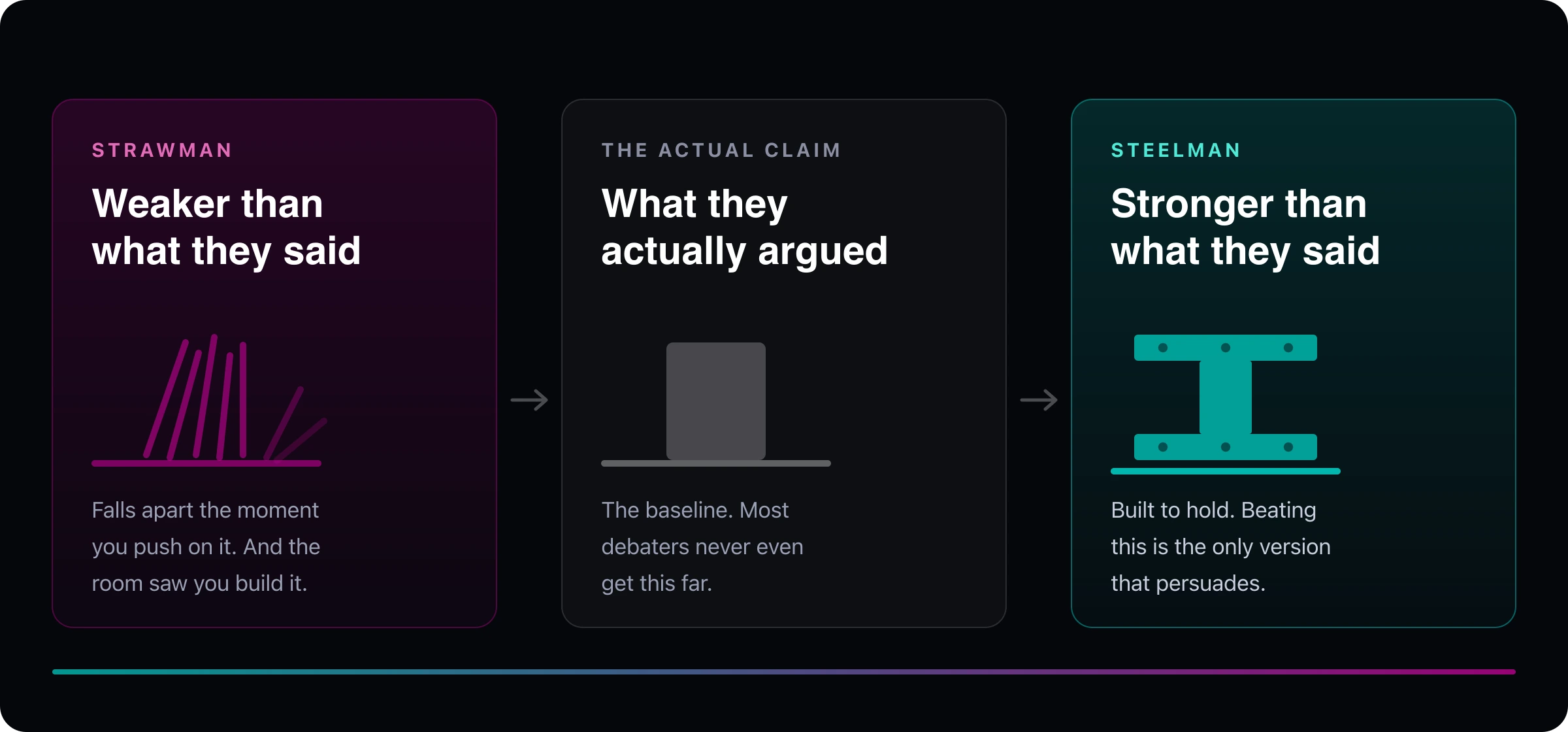
The fastest way to earn a room is to steelman your opponent: restate their argument in its strongest, most sympathetic form before you lay a finger on it.
Summarize their case more fairly than they did and two things happen at once. They relax, because they're no longer defending a caricature of themselves. And the audience decides you're arguing in good faith, which means everything you say next lands as fair rather than defensive.
What it sounds like in practice
Take one claim and watch what happens to it.
They actually said: "These restrictions should be loosened."
The strawman version: "So you're saying we should just let anyone do whatever they want." Nobody said that, and the room can tell.
The steelman version: "Your strongest point is that restrictions like this have historically been applied unevenly, and the burden usually lands on the people least able to object. Let me take that seriously."
The third version costs you nothing. It buys you the room.
It also does something less obvious. It forces you to actually understand the opposing case, which is the only reliable way to find the real weakness in it. Most people never get there because they're too busy arguing with a version of their opponent they invented.
Beating a strawman convinces nobody, least of all the undecided people you're trying to reach. They can see exactly what you did.
So find the best version of your opponent's case and dismantle that one. If you can't, you might be wrong. Better to discover that in preparation than in front of an audience.
This is the least comfortable habit on the list, because it means deliberately making your own job harder. It's also what separates debaters people trust from debaters people merely watch.
Here's a test worth running before any debate. Write out your opponent's best argument by hand. If you can't make it compelling, you don't understand it yet, and you are not ready to argue against it.
"You're right about that" is not surrender. It's a scalpel.
Concede the point that doesn't decide the debate, then pivot straight to the one that does. Audiences reward visible honesty and punish stubbornness. A well-placed concession costs you ground you were going to lose anyway, and buys you credibility on every claim you don't concede.
How you do it matters more than whether you do it:
- Concede early. A concession dragged out of you reads as defeat. One offered freely reads as confidence.
- Concede specifically. "You're right that the 2019 numbers don't support my framing" lands. "You make some good points" is filler and everyone knows it.
- Never concede the motion. Give ground on evidence, framing, edge cases. Not on the thing you came to defend.
- Pivot in the same breath. "You're right about that. And it's exactly why the second point matters more than either of us said."
The debater who concedes nothing at all looks like someone who isn't listening. The audience clocks it long before the opponent does.
Good questions do more work than good speeches.
A speech asks the audience to accept your reasoning. A question makes your opponent generate the reasoning themselves, live, on the record, in front of the people deciding.
The move is to ask something narrow enough that only two answers exist and both of them help you. Either they agree with you, or they defend a position the room can already see is indefensible.
| Bad question | Why it fails | Better |
|---|
| "Don't you think that's unfair?" | A flat "no" costs them nothing | "Which specific group benefits under your proposal?" |
| Long multi-part setups | They answer the easy part and drop the rest | One clause, one answer |
| Gotcha framing | The room sides with whoever got ambushed | Genuine curiosity, precise target |
Then, once they answer, stop talking.
The most common mistake in debate is asking a good question and immediately burying the answer under commentary. Let the silence sit there. The room heard it. You explaining why it was damaging is what makes it sound less damaging.
When the stakes peak, almost everyone speeds up. Do the opposite.
Adrenaline compresses speech, and compressed speech sounds anxious no matter how strong the content is. At the decisive moment, deliberately drop your pace. Shorten the sentences. Put a beat in front of the line that matters most.
A slow, specific sentence delivered under maximum pressure reads as total confidence, and confidence is contagious. Audiences take their emotional cue from whoever seems least worried about how this ends.
Of everything here, this is the most trainable. Record yourself and listen for where you accelerate. That spot is where you're least sure of your ground, and now you know what to go work on.
None of the above survives if the first time you attempt it is live, with an audience, against someone trying to beat you.
- Steelman something daily. Pick an opinion you disagree with and write its strongest form. Five minutes, no cheating.
- Rewatch yourself for pace, not content. Find the moment you sped up.
- Rehearse your concessions. Take the two points you're most likely to lose and script how you'll hand them over profitably.
- Prepare three questions instead of three speeches.
Debate is closer to a physical skill than an intellectual one. The arguments were never the hard part.
The other half of the training is watching. Pick any live debate and stop tracking who you agree with. Track who the room is moving toward, and what they did in the thirty seconds before it moved.
You are not really arguing with your opponent. You're arguing to the room.
Your opponent is not going to concede. Almost nobody does, live, under pressure, in front of people. Treating them as the target is the mistake that produces shouting matches: two people demanding a surrender that was never available.
So watch the people who haven't decided. They're the only ones who can hand you the win, and they're persuaded by precisely the things volume destroys. Fairness. Precision. Composure. The visible sense that you would rather be right than loud.
Win them and it won't matter how quietly you did it.
That's the whole design behind how a Moral Kombat debate works: the audience votes, so the audience is the point. Nobody is scoring you on volume.